
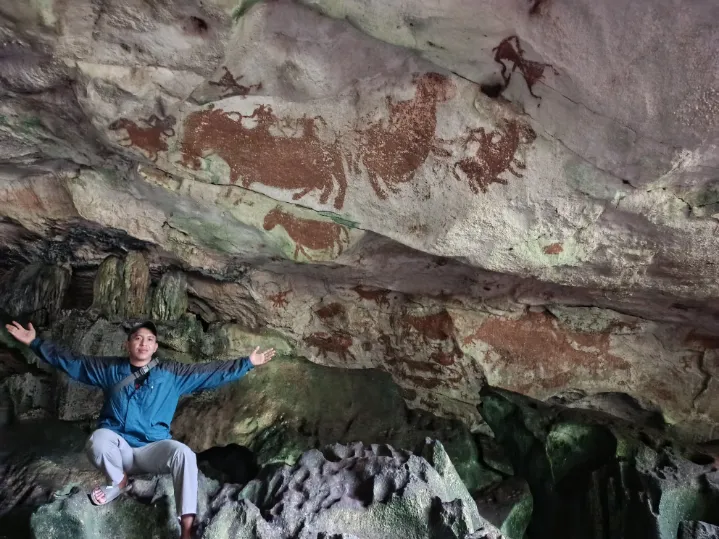
Exploring Ancient Cave Art and Cultural Heritage on Muna Island
A research-led explanation of Liang Metanduno, Liang Kabori, dating evidence, and responsible cave-art visitation.
Understand Muna ancient cave art through archaeological evidence, karst context, local interpretation, conservation, and respectful travel.
Ancient cave art changes the way a traveler sees Muna Island. A cave is no longer only a natural space with dramatic rock and darkness; it can also preserve evidence of human expression, movement, and imagination. That evidence must be approached differently from an ordinary attraction because the surface may be fragile, the interpretation may be complex, and careless visitation can cause permanent damage.
This article concentrates on Liang Metanduno and the wider Liang Kabori landscape. It explains what current research establishes, what it does not establish, how dating evidence should be described, and how travelers can visit without turning heritage into a photograph-only experience. Operational access, local guides, rules, and fees require confirmation before departure.
Why Cave Art Requires a Different Kind of Travel
A cave-art visit is not simply an adventure activity. The visitor is entering a place where natural formation and cultural evidence exist together. The route may involve uneven ground and darkness, but the main value may be the chance to understand a fragile record of past human activity. Visitors should prepare to observe carefully, listen to interpretation, and accept limits on movement or photography.
This difference also changes the language used in promotion. A heritage site should not be described only as beautiful, secret, or dramatic. The article should explain what has been documented, identify uncertainty, and make conservation behavior part of the travel expectation.
Liang Metanduno and the Studied Hand Stencil
Nature research published in 2026 reported LA-U-series dating of calcite overlying a hand stencil at Liang Metanduno. The dated calcite was reported at approximately 71.6 plus or minus 3.8 thousand years. Researchers used that result to establish a minimum-age constraint of about 67.8 thousand years for the underlying motif.
That statement must stay tied to the studied hand stencil and the overlying calcite. It does not mean every painting on Muna is 67.8 thousand years old. It also does not directly identify the individual person or group that made the mark. Preserving this precision is essential when translating scientific research into travel writing.
What a Minimum-Age Constraint Means
A minimum-age constraint means the underlying motif must be at least as old as the dated material that formed over it, within the study’s method and uncertainty. It is not the same as directly measuring the pigment or proving the exact date when a person made the stencil. This distinction is easy to lose in a short headline, but it matters to anyone who wants to understand the evidence honestly.
Travelers do not need to perform the dating themselves. They do need to avoid turning a precise result into a broad slogan. A careful guide can communicate the importance of the finding while acknowledging that archaeological interpretation depends on material relationships, methods, comparisons, and continuing research.
Muna Rock Art in a Regional Human History
Liang Metanduno matters beyond one cave because it contributes to wider questions about early human presence and symbolic expression in Sulawesi. Regional research compares motifs, techniques, dating evidence, and environmental settings, but comparison does not erase the identity of each site. Muna should be understood through its own evidence and landscape.
This regional context gives visitors a reason to learn before arriving. A cave-art visit can connect local heritage with a broader human story while still respecting the fact that many questions remain open. Avoid claiming that one image proves an entire migration history or that a single site explains every early human movement in the region.
Liang Kabori and the Wider Cave-Shelter Context
Academic research associated with Liang Kabori identifies a landscape of caves and shelters with figurative and nonfigurative rock-art motifs. This matters because Muna’s heritage is not represented by one isolated panel. Different shelters may preserve different visual choices, surface conditions, and relationships between people and the karst environment.
Liang Kabori should not be used as a replacement name for Liang Metanduno. Each site needs accurate identification, its own evidence, and its own access rules. The value of the wider landscape is that it gives scale and context without merging destinations that researchers and local communities distinguish.
Natural Cave Formation and Cultural Surface
A cave-art site contains two layers of attention. The first is the natural cave: rock, shelter, moisture, light, and terrain. The second is the cultural surface: pigment, motif, calcite, archaeological material, and the surrounding evidence that researchers interpret. A visitor can appreciate the first without touching or approaching the second.
Guides can help explain which walls are ordinary formations and which surfaces require strict protection. Travelers should not assume that a visually blank wall is safe to touch or that every mark is ancient art. When uncertain, keep distance and ask. Caution is preferable to accidental damage.
How to Visit Liang Metanduno Respectfully
Follow the access route, remain with the group, and obey local instructions about distance, light, flash, group size, and photography. Never touch, wet, trace, chalk, scratch, or lean equipment against art or archaeological surfaces. Oils, moisture, and dirt can alter fragile material, while repeated close contact can create damage that is difficult to reverse.
Do not remove stones, fragments, pigment, or natural formations. Carry food and rubbish out if facilities are unclear. The best heritage visit is one in which the site looks unchanged when the group leaves.
The Role of Local Interpretation
Local guides can provide access knowledge, place names, community expectations, and explanations that are not visible in an image. Their knowledge may include oral history and local memory, while academic research addresses questions through different methods. Both can contribute to understanding when their roles are identified clearly.
Visitors should not pressure guides to invent a dramatic story or allow restricted access. Ask where a claim comes from and listen to uncertainty. A guide who says a detail is unknown is protecting the integrity of the site rather than failing to entertain.
Oral History, Memory, and Archaeological Evidence
Oral history can preserve community relationships with places, names, routes, and memories. Archaeological research can analyze materials, motifs, dating, and environmental context. These forms of knowledge should not be forced into one category. A local story can be meaningful without being a laboratory result, and a scientific result can be important without replacing community memory.
A responsible article presents each source honestly. This helps readers appreciate culture without turning local people into evidence for a claim they did not make. It also prevents research findings from being simplified into a story that the available data cannot support.
Photography and the Ethics of Sharing Heritage
Photography should follow site rules and local permission. Do not use flash or equipment where it is restricted, and do not place tripods, bags, hands, or cameras against a surface. At community locations, ask residents before photographing people, homes, boats, or work.
Online sharing requires accurate captions. Identify the exact site, distinguish the visible image from the research interpretation, and do not imply that every cave on Muna contains the same art or age. Avoid geotagging sensitive locations when local managers advise against it.
Heritage Travel for Families and Small Groups
Families can visit heritage sites when the physical route, quiet behavior, and access rules are explained in advance. Children should remain supervised and should understand that walls and surfaces cannot be touched. Older travelers or people with mobility concerns should ask about the approach, footing, rest points, and whether an alternative interpretation is available.
Small groups may make interpretation easier, but they do not receive automatic permission for closer access. Every visitor remains responsible for following the same conservation rules.
How Heritage Fits a Wider Muna Itinerary
A heritage route can combine Liang Metanduno or Liang Kabori with a natural cave, a lake, a coastal community, or Meleura. Each location should retain its own purpose. A lake can provide a calm landscape context, a cave can show karst formation, and a village can introduce living maritime culture. Do not compress all these experiences into one generic claim about ancient Muna.
The final order should follow access, weather, group stamina, guide availability, and conservation requirements. A local operator should confirm which sites are actually open and included.
Preparing Before the Visit
Ask the operator which exact cave or shelter is included, who provides interpretation, and what rules apply to photography. Confirm transport, walking distance, footwear, lighting, weather alternatives, entrance arrangements, and group size. Ask whether the site has current access restrictions or conservation work.
Bring practical shoes, water, personal medication, rain protection, and only the equipment permitted by the guide. Avoid bringing tools or objects that encourage collecting, touching, or scraping.
How Research Should Be Updated
Heritage knowledge develops as new studies, dating results, conservation assessments, and local management decisions become available. Laode Traphel should date operational information and update research references when stronger or newer evidence changes the explanation. A single field report should not automatically become a permanent rule.
Readers should confirm current access and local guidance before departure. A web article can explain the significance of a site, but it cannot replace specialist conservation management or local coordination.
What Visitors Can Contribute
Visitors contribute by learning before arrival, using local guides, respecting community boundaries, and leaving the site physically undisturbed. They can also share accurate information rather than repeating exaggerated age claims or unsupported stories. If a local host requests that images not be published, that request should be honored.
A responsible visit can support conservation indirectly by demonstrating that heritage travel is possible without damage. It can also encourage operators to invest in interpretation instead of relying only on dramatic photographs.
Final Perspective on Muna Cave Art
Liang Metanduno and Liang Kabori invite travelers to think about time, evidence, place, and human expression. The research is powerful because it is precise, not because it gives permission to simplify everything into a headline. The caves are natural spaces, but the art makes them cultural environments that need additional care.
Travelers who observe without touching, listen without demanding certainty, and share information accurately can experience Muna heritage with depth. The goal is not merely to visit an old surface. It is to understand why the evidence matters and help ensure that it remains available for future study and respectful visitation.
The Difference Between a Motif and Its Interpretation
Visitors may see a hand stencil, an animal form, a geometric mark, or a faded surface, but seeing a motif does not automatically reveal its meaning. Interpretation can draw on style, comparison, context, dating, and local knowledge. A travel article should avoid assigning a single symbolic explanation when the available evidence does not support it.
This uncertainty does not make the site less interesting. It invites travelers to look more carefully and accept that archaeology often works through questions rather than complete answers. The responsibility of the visitor is to protect the material so future research can continue.
Why Cave Conditions Affect Heritage
Moisture, air movement, temperature, dust, light, and human contact can influence cave surfaces. Even when a visitor cannot see immediate damage, repeated touching or uncontrolled movement may alter a fragile panel. This is why guides may limit group size, distance, or photography.
Travelers should regard those limits as part of the heritage experience. A cave is an environment with its own conditions, not a gallery designed for unlimited traffic. Following the route protects the evidence and makes the visit more respectful to researchers, local managers, and future visitors.
Preparing Children and First-Time Visitors
Children can learn from cave heritage when the visit is explained in simple terms before arrival. Tell them that the walls may contain evidence and that hands, bags, and objects must stay away from the surfaces. Keep the group close and choose a route whose physical demands match the child’s ability.
First-time adult visitors also benefit from a short briefing. Explain why flash or touching may be restricted, how to ask questions, and why a guide may stop the group. Preparation reduces accidental behavior and allows visitors to focus on the story rather than discovering the rules too late.
Heritage, Tourism, and Community Benefit
Heritage tourism should create value without turning sites into commodities that lose their meaning. Local guiding, transport, community hosting, and interpretation can help residents participate in the visitor economy when arrangements are transparent and locally supported.
Travelers can ask how their booking supports local services and whether a community contribution is included. They should not assume that every payment reaches the same destination or that cultural labor is free. Clear arrangements protect both visitors and hosts.
A Careful Way to Share the Story Online
When sharing a Muna heritage story, identify the exact site, mention the source of major research claims, and avoid publishing restricted access details if local managers advise against it. Do not encourage readers to touch, climb, enter without guides, or search for unmarked panels.
Use language that communicates significance without exaggeration. A precise account of the Liang Metanduno evidence is stronger than a vague claim that all Muna cave art is the oldest in the world. Accuracy invites trust and reduces harmful expectations.
Why Preservation Is Part of Cultural Discovery
Preservation can feel invisible when a site appears unchanged, but that unchanged condition is the result of care. Limiting contact, reducing dust, controlling light, and guiding visitors all protect the possibility of future study. A traveler may never see the work behind conservation, but can support it by following simple rules.
The cultural experience becomes deeper when visitors understand that access is a responsibility. The site is not a product consumed once and replaced. It is evidence shared across generations, and every visit should leave it available for the next researcher, guide, and community member.
How to Ask Better Questions at a Heritage Site
Useful questions ask about evidence and care: What material was dated? Which panel was studied? Who manages access? What should visitors avoid? How does the community participate? These questions are more respectful than asking only for the oldest claim or the most dramatic photograph.
A guide may not have every scientific answer, and that is normal. The group can note the question and seek a published source later. Curiosity should create a path toward learning, not pressure a host to provide certainty where the evidence remains incomplete.
Leaving with Knowledge Rather Than Material
The best heritage souvenir is a more accurate understanding of the place. Travelers can write down the correct name, remember the conservation rule, support a local guide, and share a caption that does not exaggerate the research. These actions extend the value of the visit without removing anything from the site.
Liang Metanduno and Liang Kabori deserve this approach because their significance depends on material that cannot be replaced. Careful visitors help ensure that cultural discovery remains possible long after their own journey ends.
A Lasting Heritage Experience
The strongest cave-art experience continues after the visitor leaves. It appears in the care taken when sharing an image, the accuracy used when repeating a research finding, and the respect shown when recommending the site to another traveler. Heritage is protected not only inside the cave but also through the expectations created outside it.
Muna’s ancient art deserves curiosity without careless certainty. A visitor who leaves with precise knowledge, respect for limits, and support for local interpretation has contributed to a future in which the site can still be studied and understood. That responsibility belongs to operators, writers, guides, researchers, and visitors together. Careful cultural tourism can connect scientific knowledge with local dignity while keeping the physical evidence protected for future generations. The result is a visit that teaches, protects, and respects the island for everyone. It also reminds visitors that preservation is a shared responsibility, not a rule reserved only for specialists, for future generations and careful study.
Frequently Asked Questions
Where can visitors learn about ancient cave art on Muna Island?
Liang Metanduno is the main research-focused site in the project data, while Liang Kabori represents a wider cave and shelter rock-art landscape.
How old is the Liang Metanduno hand stencil?
Nature research reported a minimum-age constraint of about 67.8 thousand years for the studied hand stencil based on dating overlying calcite.
Does the dating apply to every Muna cave painting?
No. The result applies to the specific studied evidence and should not be generalized to every image or cave.
Can visitors photograph the art?
Photography depends on local conservation rules. Ask before using cameras or flash and never touch or approach surfaces beyond the permitted distance.
What is the most important visitor rule?
Observe without touching, follow local guidance, respect community consent, and leave all natural and cultural material in place.
Plan your journey with Laode Traphel.
You May Also Like
Binongko Island Travel Guide for Discovering Traditional Island Culture
Binongko, Wakatobi
.webp)
The Best Cultural and Historical Experiences to Discover on Muna Island
Muna
.webp)
The Most Beautiful Caves and Ancient Heritage Sites on Muna Island
Muna
The Best Cultural and Historical Destinations to Visit in Buton
Buton Island and Baubau
10 Amazing Places to Explore in Wakatobi for an Unforgettable Journey
Wakatobi
A Complete Wakatobi Travel Guide for Exploring Islands Reefs and Culture
Wakatobi